

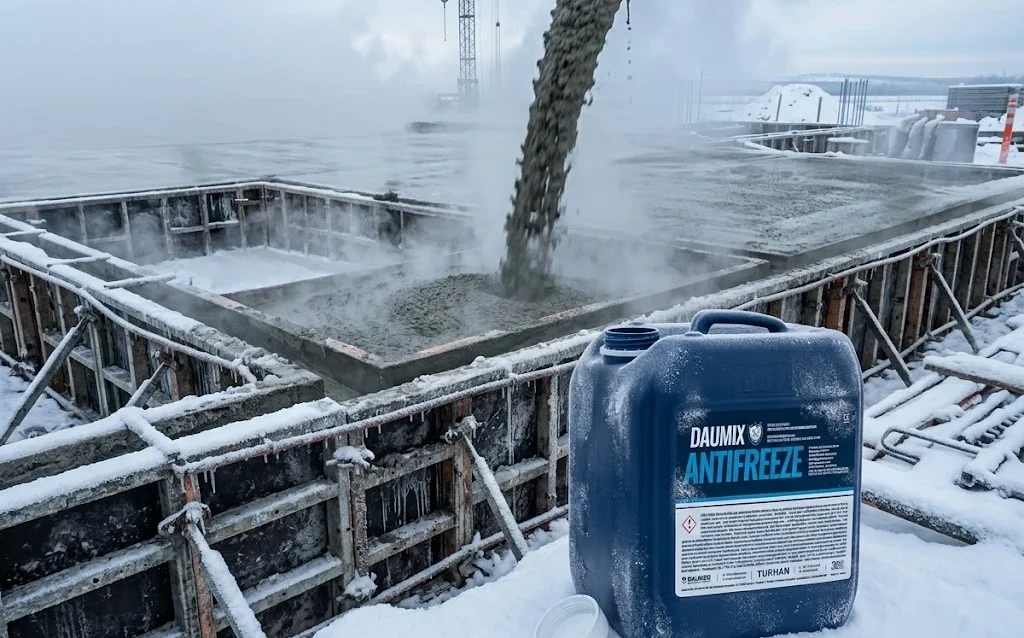
Meteo profiles dictate the internal thermodynamic behavior of fresh concrete. Pouring concrete during freezing winter conditions exposes the mix to ice formation, which halts the chemical hydration reaction and causes expansive damage to the internal matrix. Conversely, during summer peaks or when pouring massive blocks like dams, raft foundation grids, and bridge piers, the fresh paste flashes too fast. This causes weak interfaces known as “cold joints” and drastically raises internal hydration heat, inducing deep thermal cracking.
The Solution: Controlling Hydration Kinetics Based on Ambient Climate Daumer engineers specialized reactive admixtures designed to optimize structural reaction windows across extreme seasons:
- Anti-Freeze Shielding for Winter Sub-Zero Sites: To sustain structural concrete placement through freezing hazards, incorporating DAUMIX ANTIFREEZE is essential. Fully compliant with TS EN 934-2 Table 6, it accelerates setting kinetics at low temperatures, ensuring rapid early-strength development to bypass frost cycles. Formulated with a strict non-chloride profile, it leaves internal reinforcing steel completely safe from korozyon.
- Time Management for Mass Concrete and Summer Pours: For long-transit ready-mix operations or heavy-volume mass concrete casting, deploying DAUMIX PROCAST setting retarder is mandatory. Certified under TS EN 934-2 Table 8, it safely extends the fresh workability profile from 1 up to 24 hours, guaranteeing cold joint prevention and dissipating hydration heat spikes.