

In heavy industrial plants, multi-story parking decks, and logistics hubs, the primary structural vulnerabilities are saw-cut joints and structural building dilatations. Due to heavy wheel loads and continuous thermal contraction, these structural voids undergo persistent movement. Utilizing lower-grade sealants causes joint shoulders to fracture under forklift traffic, allowing aggressive moisture to degrade the sub-base and generate catastrophic floor failure.
The Solution: Non-Sag Vertical and Self-Leveling Horizontal PU Sealants The execution vector strictly dictates selecting specialized single or multi-component polyurethane chemistries:
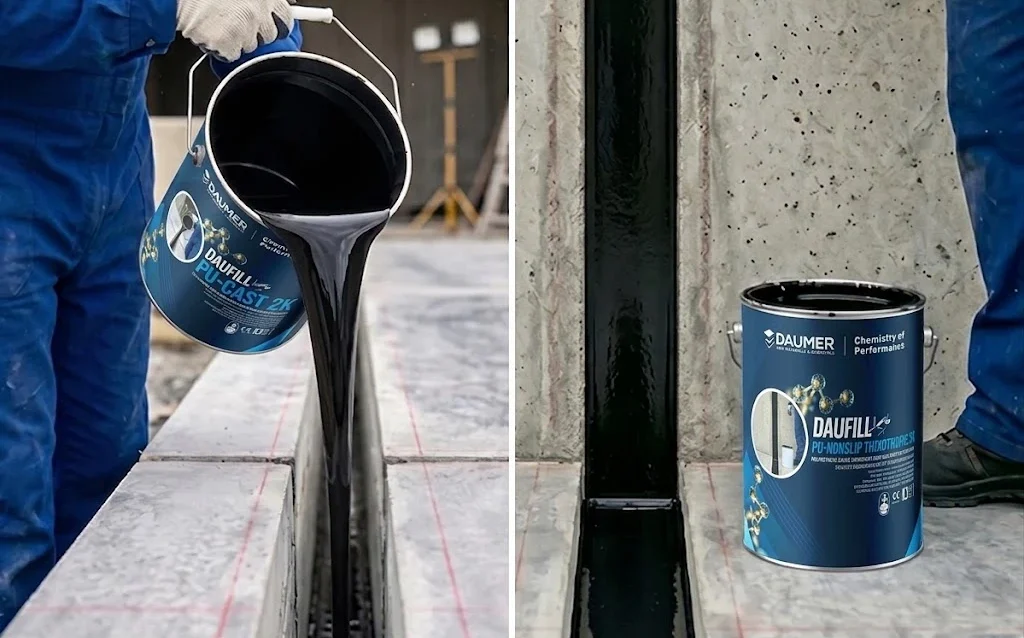
- High-Load Horizontal & Runway Joints: For industrial floor alignments and airport runways exposed to severe shear stress, the two-component, fluid-grade DAUFILL PU-CAST 2K must be specified. Maintaining deep flexibility from $-40^\circ\text{C}$ up to $+80^\circ\text{C}$, it provides supreme tear resistance.
- Vertical Wall & Retaining Dilatations: To secure vertical facade junctions without material slump, the quartz-sand reinforced, non-sag DAUFILL PU-NONSLIP THIXOTROPIC 3K ensures steady adhesion.
- General Assembly & Structural Sealing: For prefabricated joints and roofing details, the single-component, 25% movement capacity DAUFILL PU-40 sausage sealant is the ideal field choice. Backed by BS 6920 certification, it is completely safe for deployment in potable water distribution lines.